The Sustainable Development Fee: What Your Investment Funds
Understand Bhutan's USD 100 daily Sustainable Development Fee not as a cost but as direct investment in national well-being. Learn exactly where your contribution goes—from free healthcare to forest protection—and why this fee purchases the solitude and preservation that make Bhutan extraordinary.
TLDR
The SDF ($100/day) funds free healthcare and education for all Bhutanese, environmental conservation maintaining 70%+ forest coverage, and cultural preservation. This 'high-value, low-volume' policy creates the uncrowded, pristine experience that defines luxury Bhutan travel.
Reframing Cost as Investment
Bhutan is expensive. There's no circumventing this reality—the daily Sustainable Development Fee (SDF) alone amounts to USD 100 per person per night, a sum that exceeds entire daily budgets in neighboring destinations. Many travelers dismiss Bhutan on cost alone, never examining what this fee actually purchases.
Yet within that examination lies understanding that transforms cost perception entirely. The SDF isn't a tax extracted by government but an investment in national well-being—aligned with Bhutan's Gross National Happiness philosophy—with tangible, documented outcomes. Understanding this mechanism reveals why Bhutan's "expensive" travel ultimately delivers value impossible in cheaper destinations.
The High-Value, Low-Volume Policy
Since opening to tourism in 1974, Bhutan has deliberately limited visitor numbers to prevent the cultural and environmental degradation seen elsewhere. Initially enforced through strict quotas, policy evolved into economic mechanism: pricing that filters volume rather than administrative restriction.
The current SDF of USD 100 per person per night (reduced rates apply for Indian nationals and children) serves multiple functions:
- Revenue generation: Funds national development independent of aid dependency
- Crowd control: Keeps visitation within sustainable limits
- Quality filter: Attracts travelers valuing quality over quantity
- Environmental protection: Funds conservation directly
The result: approximately 315,000 visitors annually (pre-pandemic peak) in a country that could physically accommodate millions. Tiger's Nest receives perhaps 200-300 daily visitors rather than the thousands that overwhelm Machu Picchu or Angkor Wat.
Where the Money Goes
The government publishes SDF allocation, demonstrating tangible outcomes:
Free Healthcare for All Citizens
Every Bhutanese citizen receives healthcare at no personal cost. The network extends from district hospitals to remote basic health units, staffed by doctors trained domestically and abroad. Specialized treatments unavailable locally are provided internationally at government expense.
This isn't token healthcare but substantial service. Life expectancy increased from 48 years in 1984 to over 70 today—a transformation funded substantially by tourism revenue.
Free Education Through University
From primary through tertiary levels, education costs students nothing. The Royal University of Bhutan and numerous secondary schools operate on government funding. Students receive not merely tuition coverage but stipends, textbooks, and boarding support.
Literacy increased from effectively zero in 1960 to over 70% today. English serves as the medium of instruction from primary school, producing a population that communicates easily with international visitors.
Environmental Conservation
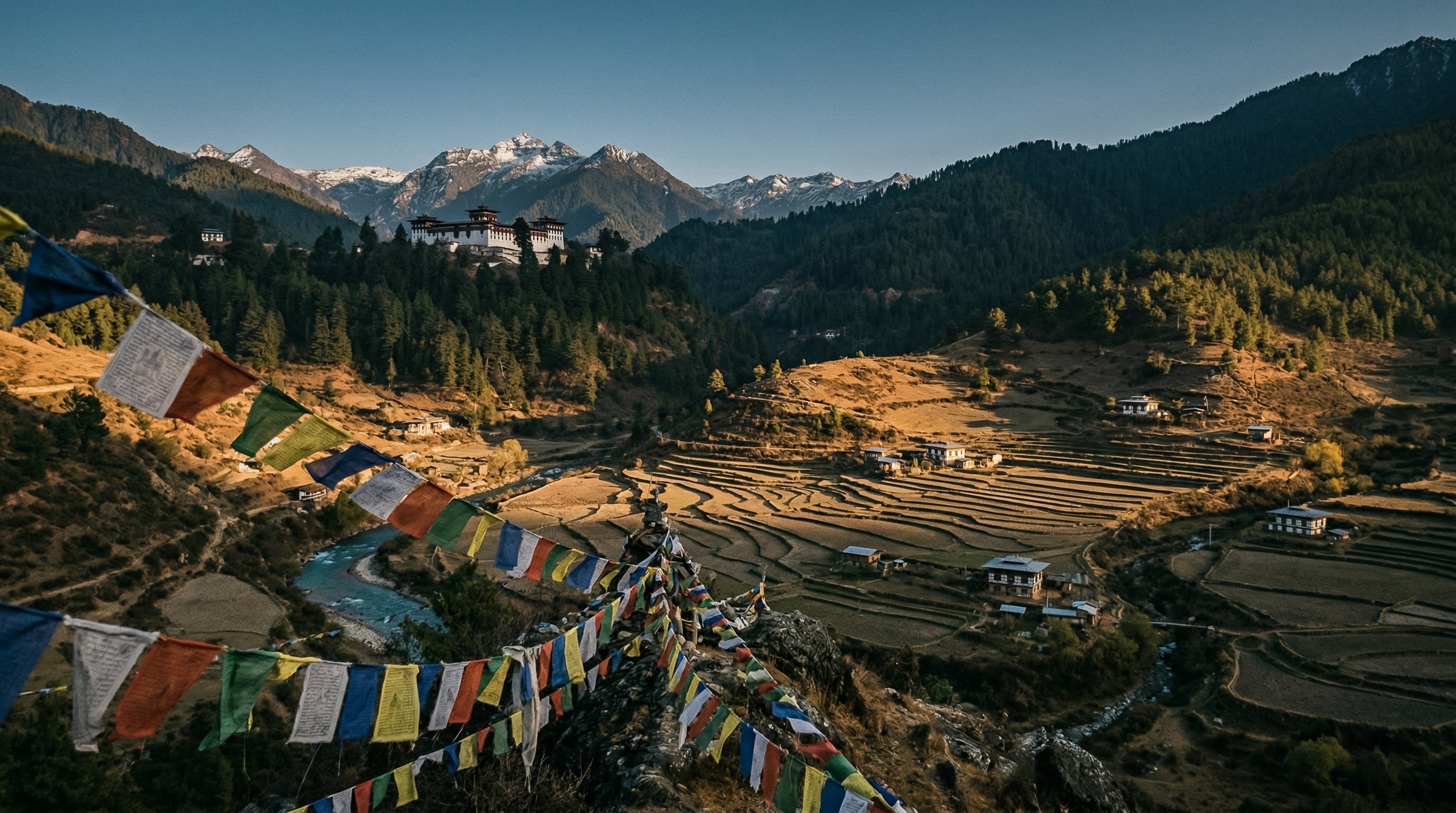
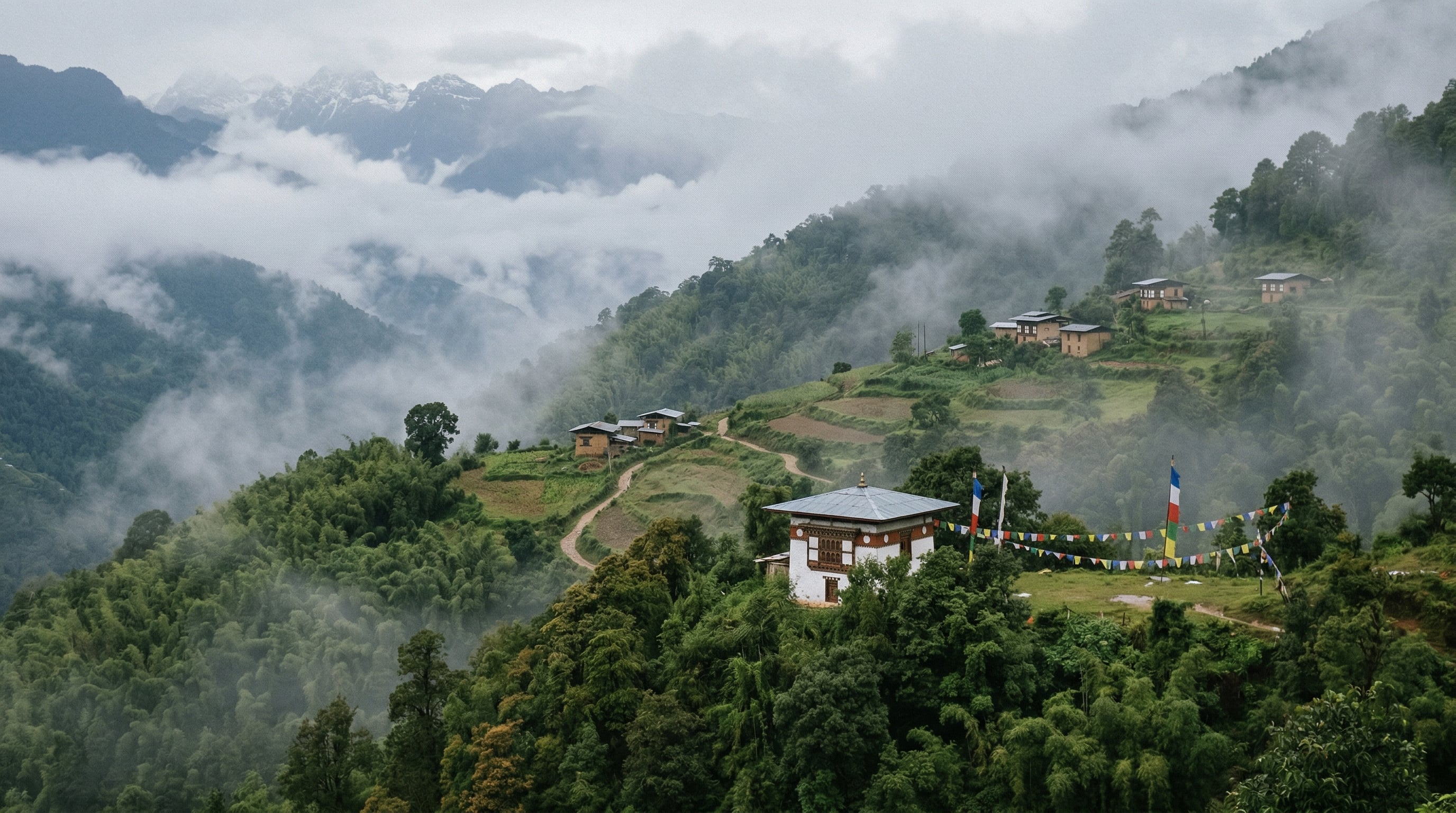
Constitutional mandate requires Bhutan maintain 60% minimum forest coverage; current coverage exceeds 70%. Enforcement requires rangers, protection programs, and management infrastructure—funded through SDF allocation.
The result: Bhutan remains the world's only carbon-negative country, absorbing more carbon than it produces. Protected areas cover over half the nation. Snow leopards, tigers, and red pandas maintain viable populations.
Cultural Preservation
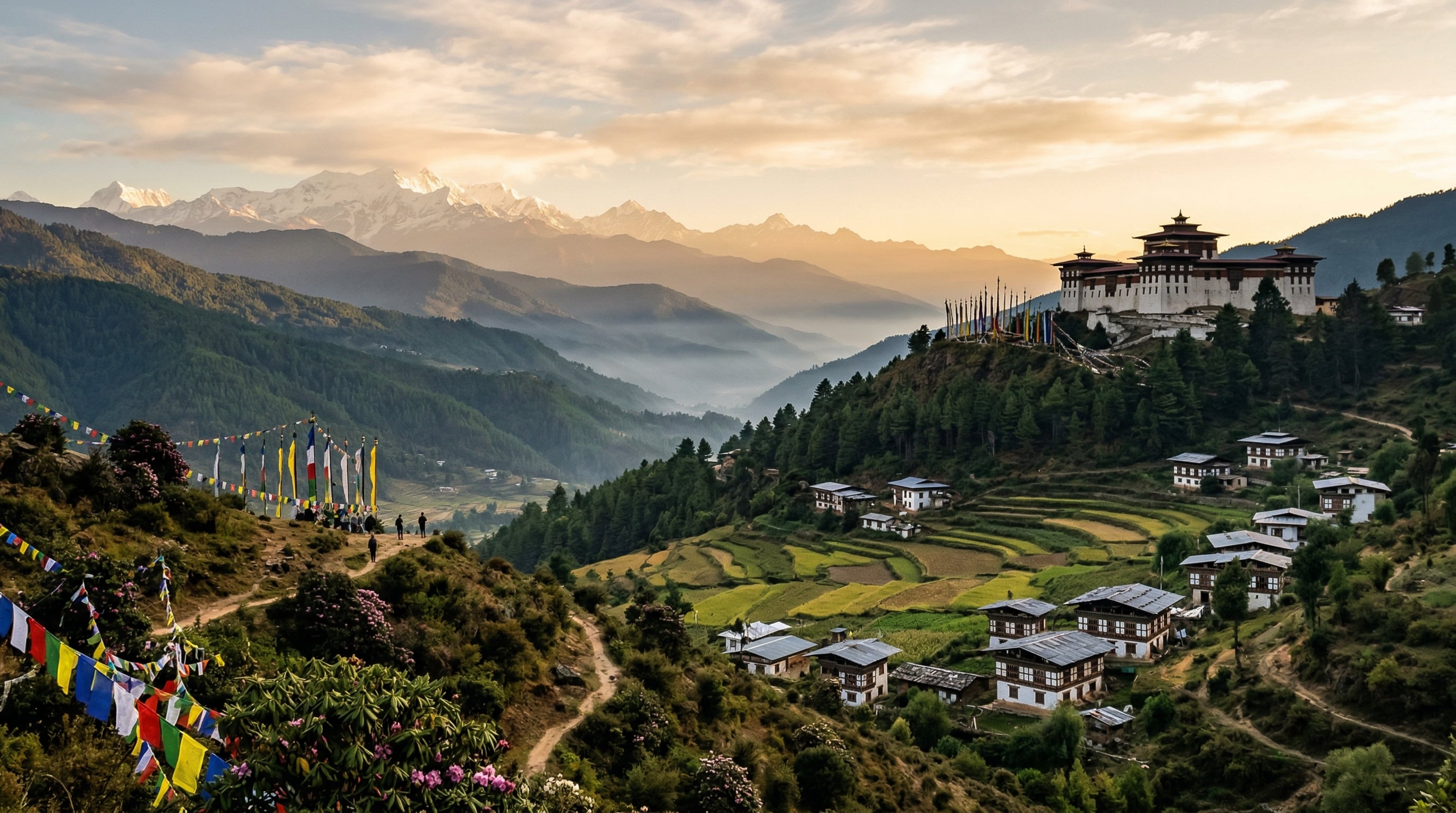
Temples undergo continuous maintenance. Traditional arts schools train new generations. Festivals receive support ensuring continuation. Language programs protect Dzongkha and regional dialects.
This investment explains why Bhutanese culture appears so remarkably intact: it isn't museum preservation but active maintenance of living tradition—visible in everything from festival schedules to how private monastery blessings still follow monastic calendars rather than tourist ones.
The Mathematics of Sustainability
Consider the alternative. Without SDF revenue:
- Volume would increase dramatically to maintain tourist receipts
- Infrastructure would strain beyond capacity
- Environment would degrade under pressure
- Cultural commodification would accelerate
- The distinctive experience would evaporate
Bhutan observed this pattern in Nepal, Thailand, Bali—destinations that opened widely and subsequently struggled to preserve what originally attracted visitors. The SDF prevents this trajectory not through restriction but through economics.
What Visitors Receive
The SDF purchases more than entrance to the country. It buys:
Uncrowded space: Those 200 daily Tiger's Nest visitors compare to 5,000 at Machu Picchu. Photography opportunities, contemplative space, safe trail conditions—all consequences of volume limits.
Preserved environment: Forest drives between valleys pass through actual forest, not logged hillsides. Wildlife sightings remain possible. Water runs clean from mountain sources.
Intact culture: Bhutanese wear traditional dress by choice, not for tourist performance. Monasteries function as spiritual centers, not admission-charging museums. Festivals maintain authentic participants.
Infrastructure quality: Roads improve continually. Airports modernize. Services maintain standards. Revenue enables development without environmental compromise.
Comparison with Tourism Elsewhere
The SDF often draws comparison to park entrance fees elsewhere—a comparison that obscures essential differences.
National park fees fund specific preserves. The SDF funds nationwide development. Park fees extract value without guaranteed reinvestment. The SDF's allocation is documented and audited.
More fundamentally: park fees exist within countries where most travel costs flow to international corporations. Bhutan's tourism model retains extraordinary value domestically, building genuine national capacity rather than expatriating profits.
Practical Considerations
Who pays: The SDF applies to all international tourists except Indian nationals (who pay reduced rates). Children 5-12 pay 50%; under 5 are free.
When paid: Typically processed by tour operators before visa issuance. Visitors don't pay directly but see the SDF as a line item in tour costs.
What's separate: The SDF is in addition to accommodation, meals, activities, and guide services. Premium tours add costs above SDF baseline.
Recent changes: The SDF increased significantly in September 2022, raising rates while simultaneously removing minimum daily spending requirements that previously applied.
The Ethical Investment
For travelers conscious of their impact—and luxury travelers increasingly define themselves this way—the SDF offers something rare: documented, positive contribution to a destination's well-being.
Unlike voluntourism of questionable benefit or carbon offsets of uncertain effect, the SDF produces measurable outcomes. Children attend school. Patients receive care. Forests remain standing. Culture persists.
This isn't virtue signaling but structural reality. Every visitor, regardless of motivation, participates in national development directly. The wealthy traveler's fee educates a rural child. The wellness seeker's contribution protects a snow leopard's habitat.
Purchasing the Priceless
Ultimately, the SDF purchases something that cannot be priced in ordinary terms: the preservation of somewhere genuinely different in an increasingly homogenized world.
Bhutan chose to remain Bhutan. The SDF funds that choice. Visitors who pay aren't merely accessing a destination—they're participating in an experiment in alternative development that the entire world watches with interest.
Is $100 per day expensive? Compared to Thailand or Nepal, certainly. Compared to the cost of losing Bhutan to the same forces that transformed those destinations? It's the bargain of the century.
Frequently Asked Questions
What is Bhutan's Sustainable Development Fee today?
International visitors typically pay USD 100 per person per night (verify current rates with your operator at booking). Reduced rates apply for Indian nationals and for children; the line item usually appears on your tour invoice alongside lodging and guiding.
Does the SDF replace the visa fee?
No. Visa processing and the SDF are separate; your tour operator normally bundles both into pre-arrival paperwork so you clear Paro with minimal friction.
What does the SDF actually fund?
Revenue supports national programs such as free healthcare and education, conservation of forests and protected areas, and maintenance of temples, festivals, and living culture—the infrastructure behind the low-volume, high-quality experience.
Is the SDF negotiable or avoidable?
It is a government levy, not a discretionary hotel charge. There is no legitimate workaround for international tourists; anyone suggesting otherwise is misleading you.
Ready to experience Bhutan?
Our concierge team crafts private, all-inclusive journeys tailored to your interests.
Written by
Bhutan & Co. Editorial Team